homeabout uswhat we docontactget involvedinformation
HOME > What we do > Pakistan
pakistan

1) Basic Information

1. Outline

CountryName Islamic Republic of Pakistan   map
Capital Islamabad
Population 152.1 million (World Bank, 2004)
Area 796,100 k㎡ (World Bank, 2004)
Ethnic Groups Punjab, Sind, Pathan, Balochi
Languages Urdu
Religions Muslim
Source:Ministry of Foreign Affairs Official Website

2. Situation after the Disaster

A devastating earthquake of 7.6 in magnitude hit the northern part of Pakistan on 8 th October 2005. The death toll reached over 70,000 in the North Western Frontier Province (NWFP) and Azad Jammu Kashmir (AJK), in addition to 3,5 million survivors affected by the disaster. People lost their houses and all their belongings. Recognizing the need for emergency assistance as the highest priority, on the 9 th of October, the day after the earthquake, JEN dispatched its staff to Pakistan and started its emergency aid activities.

JEN's target area is Bagh District in AJK, particularly the eastern part of the district called Haveli, which has seen little aid. Most aid agencies focused their activities along the main roads, thus neglecting remote areas such as Haveli. The majority of the affected areas in Haveli are in the mountains and difficult to reach. The landslides resulting from the earthquake also hinders effective delivery of aid to these areas.


2) JEN's Activities in Pakistan

1. Approach


JEN strives to deliver assistance to those who are in need and underserved, in cooperation with local people.

In order to identify the most urgent needs and priorities in the disaster areas, JEN conducted interviews to the victims of the earthquake. JEN determined the contents of its activities through coordination and information sharing with other donor agencies and NGOs. JEN targets the most vulnerable population s in the mountain areas , such as women and children, who have received little aid.


2. On-going Project

Assistance for Education

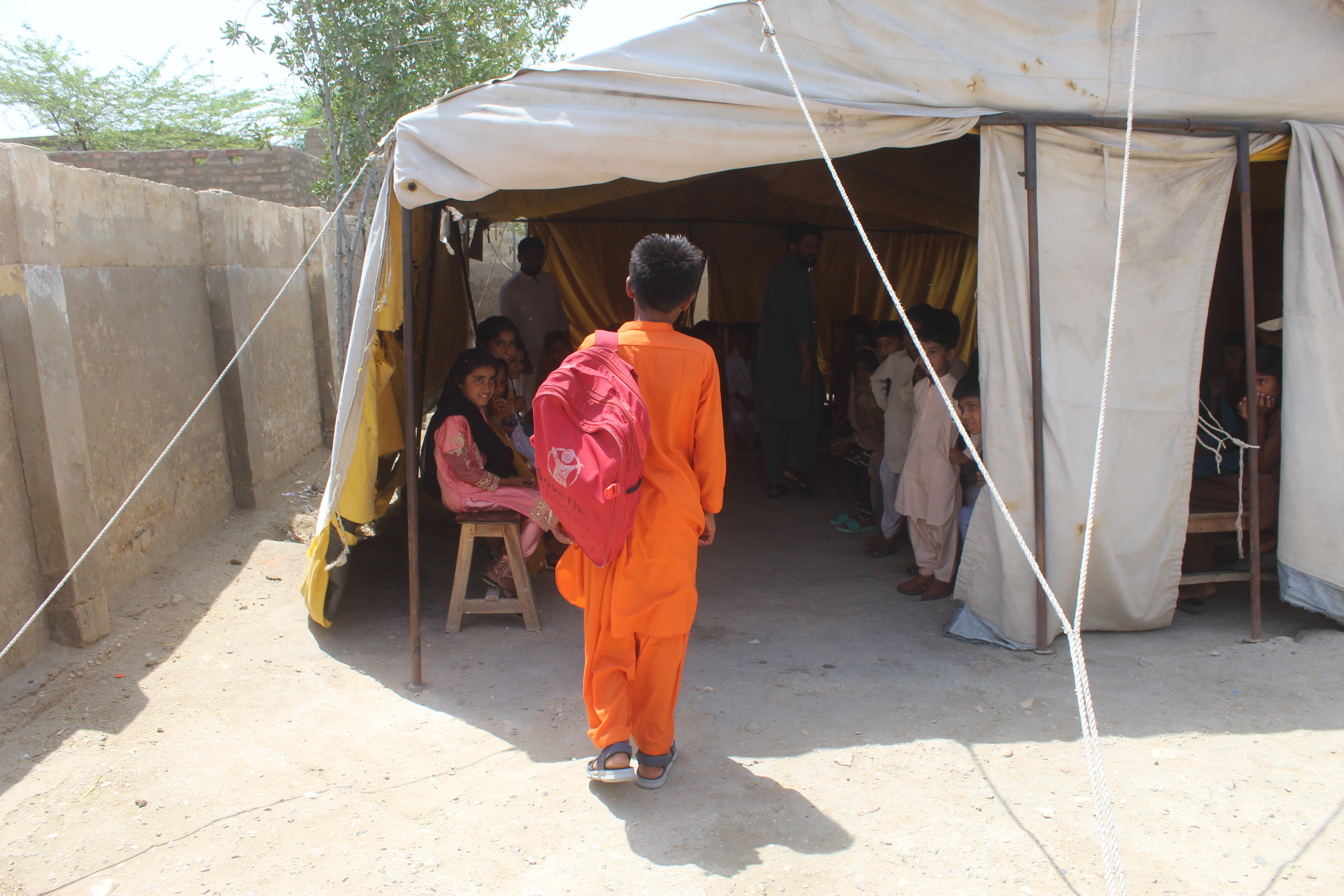
Though all schools were closed in Bagh District immediately after the quake, many of them had re-opened by mid-November. However, most school buildings have been totally or part ially ly damaged, and classes are being conducted outside in the severe cold of the winter.

Since January, JEN has been providing large tents for 250 classrooms. Also, chalkboards, stationery items, teachers' chairs, mattresses and children's winter jackets are being distributed. Several classes are effectively utilizing the tents as their classrooms, each of which can accommodate about 40 students. As JEN is the only organization in Haveli providing assistance in the education sector , its presence is regarded as highly essential by UN agencies, the local government, and local people.

3. Past Project

Distribution of Emergency Relief Supplies (October 2005 – February 2006)

In Bagh, about 10% of the houses are totally destroyed, while 90% are partly destroyed. Many people stayed outside for fear of aftershocks. Based on the results of its needs assessment s through interviews with victims , JEN distributed tents, blankets, kitchen utensils, sanitary kits and winter clothes from October to December 2005. JEN originally planned to assist 2,000 households, but in the en d assisted more than three times that number, with a total of 5,716 households.

Victims are happily using t he distributed items on a daily basis , as they were identified through the voices of victims themselves and responded directly to their needs . For example, considering that most families are large , JEN provided kitchen utensils for 6-8 people per household, which was highly appreciated by the victims .

Among the items distributed by JEN, 12,518 pieces of clothing were donated from the FIRST RETAILING CO., LTD. (UNIQLO) and 5,000 blankets by the Campaign for Sharing Blankets with People in Africa. The transportation of blankets to Pakistan was done with the support from Pakistan International Airlines, Mitsui O.S.K Lines, the Nippon Yusen Kabushiki Kaisha (NYK Line) .

Pakistan

I. Aperçu Géopolitique

Nom du Pays République Islamique du Pakistan    Plan
Capitale Islamabad
Population 152,1 million (la Banque Mondiale, 2004)
Superficie 796,100 k㎡ (la Banque Mondiale, 2004)
Groupes Ethniques Penjâbis, Sindhis, Pachtous (Pathans), Baloutches, etc.
Langues  le penjâbi (48%), le sindhi (12%), le siraiki (10%), le pachto (8%), l’ourdou (officiel, 8%), le baloutche (3%), le hindo (2%), le brâhuî (1%), l’anglais (officiel), le burushaski et autres (8%)
Religions Musulmans (Sunnites 77%, Chiites 20%), Chrétiens, Hindous et autres (3%)
Sources:Site Officiel du Ministère des Affaires Étrangère du Japon, CIA World Factbook 2007

II. Contexte Historique

  • Le 8 octobre 2005, un violent séisme d’une magnitude de 7,6 a frappé le nord du Pakistan. Le nombre de morts a été évalué à plus de 70,000 dans la Province Frontalière du Nord-Ouest (PFNO) et d’Azad- et Jammu- Cachemire (AJC).  Les 3,5 millions de rescapés sont gravement affectés par le désastre.  Une grande majorité a été privée de logements et du nécessaire vital. 

    III. Besoins Générales des Populations Pakistanaises

    JEN s’est focalisé sur le Département de Bagh dans la Province d’AJC, en particulier sur Haveli, arrondissement dans l’est du Département vers lequel s’acheminait peu d’assistance. La plupart des interventions humanitaires étaient concentré le long des principales artères du pays, négligeant les zones de montagneuses isolées comme Haveli. Les éboulements de terrain à la suite du séisme ont empêché l’acheminement des secours humanitaires durant plusieures semaines.

    IV. Nos Activités

    Tenant compte de l’urgence de l’assistance au lendemain de la catastrophe, JEN a rapidement envoyé du personnel au Pakistan et entamé des opérations humanitaires. JEN s’efforce de fournir de l’assistance aux populations marginalisées et celles qui sont les plus nécessiteuses. JEN a conduit des enquêtes auprès des victimes afin d’identifier les besoins les plus urgents et prioritaires. Également, JEN a déterminé le contenu des activités à travers la collaboration et la coordination avec les agences onusiennes, les ONG et les pouvoirs publics.

    A. Projets d’Éducation : depuis janvier 2006
     Les écoles dans le Département de Bagh ont été re-ouvertes à la mi-novembre après un mois de fermeture à la suite du séisme. Les locaux scolaires sont cependant pour la plupart complètement  endommagés. Les cours se dispensent en plein air, même pendant l’hiver.
    Depuis janvier 2006, JEN fournit des tentes-écoles qui correspondent à plus de 250 classes. Nous distribuons également des fournitures scolaires, du matériel didactiques, du mobilier et des vêtements pour écoliers.  JEN est la seule organisation humanitaire active dans l’arrondissement de Haveli. Notre présence est hautement appréciée par les agences onusiennes, le gouvernement municipal, ainsi que les populations locales.  

    B. Projets de Secours d’Urgence : Octobre 2005 – février 2006
    Nombre de Populations Cibres : 7,331 familles, environ 36,655 personnes
    A Bagh, les logements ont été détruits entièrement à 10 % et partiellement à 90 %. La plupart des victimes restaient en dehors de leurs maisons par peur des secousses secondaires. Sur la base du recensement des besoins des victimes, JEN a distribué, d’octobre à décembre 2005, du matériel de secours comme des tentes; des couvertures; des vetements. Quelques 5 716 familles ont bénéficié de nos projets, ce qui triple le chiffre de nos estimations qui étaient de 2,000 familles.

    JEN a distribué aussi  à chaque famille des ustensiles de cuisine à l’usage des 6 à 8 personnes tenant compte du fait que la plupart des familles sont larges.   Nous manifestons notre gratitude aux donateurs et aux collaborateurs de nos projets au Pakistan : la First Retailing Co. Ltd (UNIQLO) qui nous a fourni 12 518 vêtements ; la « Campaign for Sharing Blankets with People in Africa » qui a offert 5 000 couvertures ; le Pakistan International Airlines, le Mitsui O.S.K. Lines, ainsi que le NYK Line (Nippon Yusen s.a.) pour l’acheminement des couvertures au Pakistan.